Savatage Interview: Chris Caffery & Al Pitrelli talk Guitars Players, Steve Vai and speaking Paul O’Neill’s language
Written by Kahmel Farahani on July 2, 2025
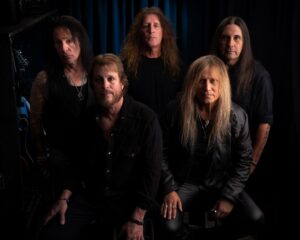
Savatage – Photo-Credit-Josh Ruzansky
In the second half of an exclusive interview with Totalrock, Savatage’s legendary guitarists Chris Caffery and Al Pitrelli spoke to Kahmel Farahani before their London show about everything from Improvising to Wolfgang Van Halen.
Totalrock: For two incredible guitar players who’ve been sharing a stage for 30 years…what’s the single best lesson you’ve learned from each other as guitar players?
Al Pitrelli: I learned from him his absolute dedication and love of what it is that he does. I have a family. He’s single. I have three boys who are all grown up and two young daughters. So, you know, I put my guitar down when I get home. I’m a dad. He never quits and I look at him and I’m inspired because he just loves this so much and he dedicates himself to this. It’s a lot of years to do that.
Chris Caffery: My thing is, first and foremost, it’s like you said, I’ve known Al since I was 17 years old, so it’s like a very long time and we are really good friends. To be able to have that out of the gate is amazing. But when I tell people flat out, I’ve worked with a lot of guitar players in my life, a lot of guitar players, and he’s by far the best all-around guitar player I’ve ever worked with. On every level. It’s like I’ve had people who are great metal players, people who do this and that stuff, but the only person that I can say is the best all-around is him. And what I learned from it is that you can never stop learning.
So I always keep trying to pick up from him whatever I can because he never stops learning. I watch him practise and play keyboards and learn more parts of music. I think it’s one of these things where when I was 16 years old, there was a level where Michael Schenker was ahead of me as a guitar player. He still has that level ahead of me as a guitar player. And that’s the same thing I see with Al. No matter how much I practise, Al keeps rising. So it’s like you see that dedication that he has, because he could have 30 years ago stopped playing and still been the best guitar player that ever played! But he doesn’t, and he makes me a better player. He makes me listen to my pitch and my bends and the things I do and my timing and how I do things. And then above and beyond that, since he has dealt with having five kids and a family, he knows how to deal with stress.
Al Pitrelli: Lot of personalities (laughs).
Chris Caffery: So I’ll watch things that might get on my nerves and he’s just like, dude, let it go. So I learned from him as a person, too.
Al Pitrelli: And we fit together like this too . I had an old boxing coach years ago who told me, you don’t box a boxer. You don’t grapple a wrestler. You know what I’m saying? So we fill in each other’s parts because Chris has just got the most incredible technique. And he’s just fucking whaling. And I’m looking at him like, I don’t know. So now dynamically, what you got going on is not two guitar players out there just shredding all over each other. After a while, It’s like, oh, dude, stop, you know? So we both have an appreciation for melodic guitar players. Chris is more from the the Schenker school. I came from, you know, the Southern Rock generation of the 70s; Jeff Beck, Johnny Winter, Skynyrd , The Allmans. So we have two different approaches, which somehow really does just work out well.
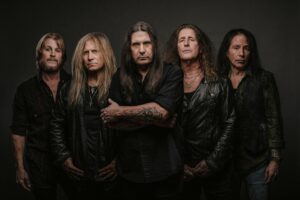
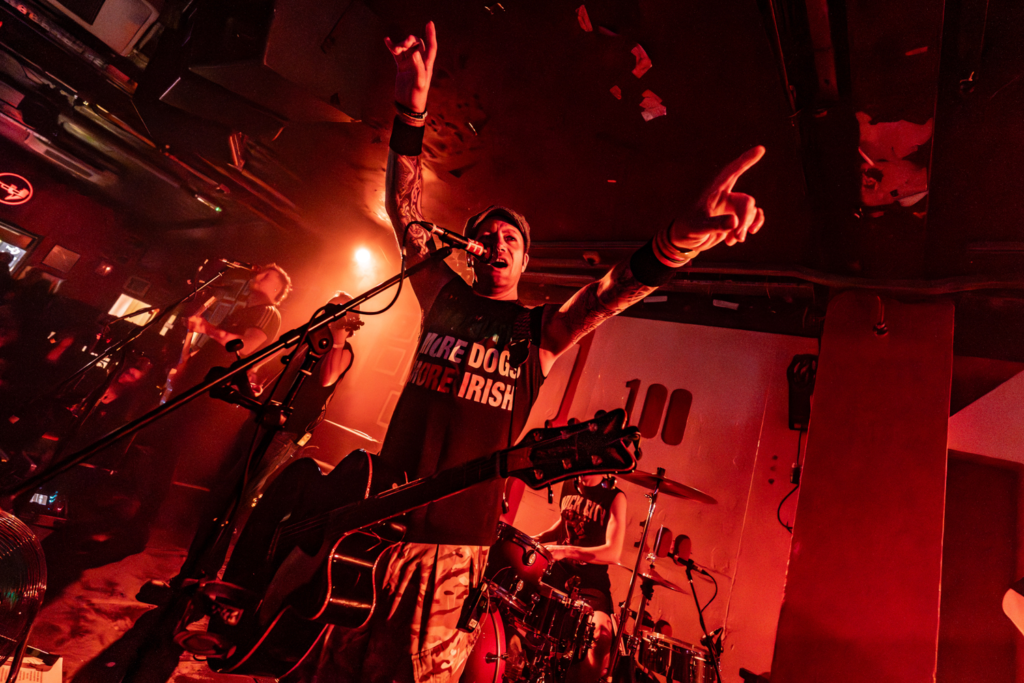
SAVATAGE: Photo-Credit-Bob Carey-2025
Chris Caffery: I did an interview earlier with this guy, Steve Black from the radio station WRF in Detroit. His first ever interview was actually was in 1990 with Savatage. And he has a thing called the Chop Shops about guitar. So he was asking me about guitar players. And he came out and asked me about Wolfgang Van Halen, what I thought. And I said something, this is not to sound cocky in the slightest, but Wolfgang is one of the few people that I hear that when I hear him play, I hear his dad. I hear that influence. He sounds like Eddie Van Halen. I was 18 years old and started working with Criss Oliva and he taught me how to play Savatage . So I know this music in a way that is similar to the way that Eddie taught his son.
So when I play it, I feel that depth inside of me with it. And all I try to do is just be the best I can be. I am never going to be the greatest guitar player in the world. I don’t have that desire. I just want to be the best I can be. But it means a lot to me that I represent one of the big reasons why we’re here, which is Criss. He created my job in the band for me. He didn’t have to. There was no second guitar player. And it was brought on for me to play. And it really wasn’t something he needed or wanted. But we became really good friends. And he brought me into the fold to do that. I was working with my brother and I walked away. And I never was able to get those years that I missed with him back. So for me, it means a lot to go in and show him how much I appreciated the fact that he gave me that opportunity back then.
Totalrock: Well, you’re celebrating them every night in the music.
Al Pitrelli: Well, going back to what we were talking about, when we first started talking about earlier, I went back and started digging into the songs with newer technology. I could listen a lot closer. Even more studious listening to these songs. I don’t remember hearing that part 30 years ago. Or, oh my god, that part or this part. You know, now in the digital world, you can hear everything on playback. God bless Chris Caffery, because if you close your eyes sometimes, it just sounds like Criss Oliva, rest his soul.
And we owe it to each generation of the Savatage over the years….prior to my involvement with this line up in ’95, you know, we go back to these earlier records and I want to do them right. You know, and I always go to him “What’s that chord?” Because he knows the shit, cold. All the guitars in the catalogue.
Chris Caffery: Although my favourite solo I get to do on this show tonight is his solo. His solo in the middle of Starlight because he forgot that he played it (laughs) And I have a wah pedal and he doesn’t. So he let me. I get to do Al’s solo, which to me is like, that’s the best, the most fun I’ve ever had.
Totalrock: Your favourite solo Al?
Al Pitrelli: In the show…probably what Chris does on Edge of Thorns. Because, you know, that’s a very naked solo. He plays it beautifully. I enjoy harmonising him on the Believe solo because he just sees how this could be a very poignant, special moment in the show. That’s a ballad. I don’t think Morning Sun is in tonight’s set, but me and Al have a little bit of fun with that. Because we were kind of alternating a few of the songs. So it’s been moving around.
Chris Caffery: I have fun listening to him do the part before The Storm. He goes and improvises.
Al Pitrelli: I have a couple of spots where I have absolutely no idea what I’m going to do. And then I’ll ask him afterwards, what did I do? (laughs). He goes, you were pretty good. I’m like, what did I do? He goes, I don’t know. At the time, you just fly by. It’s a moment in time. And when you’re that comfortable with a foundation like this band is, that gives you your moment to go out there and do your thing. And if I don’t have to think about it, I can just close my eyes and go somewhere different every night.
Chris Caffery: It’s still funny because I would go to watch him fill in for somebody in a bar somewhere. He’d go “I’ve got to do 30 songs tonight for this guy down in the village”. And I go down there and he’s got these songs written on a piece of manila paper, you know, scratch and keys and this and that. I’m like, “did you play these before?” He goes “no“. And he has the ability to play something he’s never played before like he wrote it, which is really crazy, especially in the key changing and the different positions on the neck and the song. So when he gets a chance to do that in the show, bring out that kind of spur of the moment thing, that’s the thing that I really look forward to because I never know what he’s going to play.
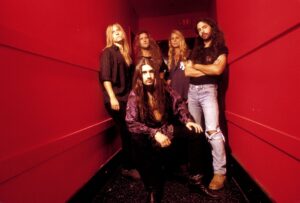
Savatage – Photo-Credit-William Hames
Totalrock: I spoke to (Savatage’s drummer) Jeff Plate a few years ago. We interviewed and I think your auditions came up and he said, you came in, you were doing the songs, and there was one point you had sheet music and you were reading off and playing something you’d never seen before. And they went, just stop, you’ve got it.
Al Pitrelli: And it was in a different key (laughs). So I had to sight transpose it . But this is not a gift bequeathed by anybody. This was, my mentor. I’ve had some very important mentor in my life. So my mentor in 1982 told me, you sound great kid. He’s only a couple of years older than me – Steve Vai. He grew up one town away from where I grew up. And I replaced him in his bar band when he went to Berkeley. And then I went to Berkeley. He joins Zappa, you know, and he’s always, he was the greatest guy ever. One of the most important people in my life.
He told me what you have to work on at all times is your rhythm guitar playing, because 90% of the evening you’ll be playing rhythm. And if you can sight read better than somebody, one day that’s going to give you an edge like you’ve never had. And if Steve Vai says something to you, if you’re smart, you’ll listen very closely. So from that moment on, I worked on my reading to the point where at the time I could pretty much sight read anything.
So what Chris is talking about, we were recording the Dead Winter Dead record. He’s in there already. I asked him, what do you want me in here for? He’s like, I just want a different approach to some things. So I approach guitar very much like I’m scoring a film. Not interested in being a guitar player. I’m interested in writing parts that bring stories to life and things like that. And then Paul O’Neill wanted me to look at Mozart And Madness. And it was Mozart’s 23rd or 24th Symphony.
And I’m like, dude, you got the score? And he goes, “you can read?” I’m like, yeah. Because why would I think nobody else could? And he put the score in front of me. It was written, I think it was B-flat on the score and the record’s in a different key. And I’m playing the notes. He’s like, well, that sounds like it might be in a different key. I said, rewind. Literally rewind. It was tape at the time. And I played it. I was looking at the notes and just in my mind, sight-transposing it. And he looked at me and he goes, “yeah, this will work”.
But going back to the devils in the details part of our conversation, nobody really knows these things. But if you do your work as an artist, if you continue to grow as artists and learn something every day or create something every day. Because forever, I will. Chris has his thing with Michael Schenker and I’ll always have my thing with Jeff Beck and Gary Moore.
Chris Caffery: If I got that sheet music and had that same thing, I would have went, “this one goes to 11” (laughs).
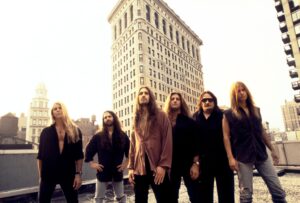
Savatage – Photo-Credit-William Hames
Al Pitrelli: But these are things that are fun stories. I share that story not because I want to talk about Steve Vai, but I want people to know what a gentleman and what a beautiful human being he is for helping me out back then . And the same thing for younger players who may be listening to what we’re talking about. Do not get too jammed up in technology. Learn to read.
If you want to be a student of music, be a student of music, don’t take the shortcut. Because what established the Dead Winter Dead record and subsequently what became the Trans Siberian Orchestra is my involvement, Chris’s involvement, the team that Paul O’Neill surrounded himself with. And the fact that I could read anything he put in front of me, open the door to him, he was like, we can do a lot of cool shit together that maybe I wouldn’t have been able to do. You know? Absolutely. So, you know, I’ll look up to Leonard Bernstein for the rest of my life as the great maestro because I want to strive to be that fluid.
Chris Caffery: Not only could Al read music though, he could read Paul O’Neill, which is not the easiest thing in the world to do. Because Paul could sing a melody to you and it would not actually be exactly what the melody is. But if you can speak fluent Paul O’Neill, you understand what it is that he did and you play it. And I’ve watched this go on in the studio with him and Al. He read fluent Paul O’Neill, which is, it’s kind of like, you’ve ever heard people do drum talk? Yes. There was a fluent Paul O’Neill that came out in a musical way and he read that too.
Al Pitrelli: He started the song, I knew what he meant. If he’s painted me a picture of bombs bursting in the air over Sarajevo when the show was playing, you know, here come the fighter bombs. And I said, I know what you’re on. You know, he played that opening ostinato, which is haunting. Which is basically The Sound Of Silence by Simon and Garfunkel. That was it. He’s like, oh my God, that’s what my film needed.
Chris Caffery: We’re doing the song Morphine Child. And it’s like he wanted an ending. And we were in the studio recording, just trying to think of it. We’re like, what do you want it to be? And he goes, “da de de da de de da da!” and it’s like, you just read it out of Paul’s head and you play the notes. At first it comes out and you’re like, what, huh? But then you understand fluent Paul. After you worked with him for a long time, you were able to get it together. But nobody was able to speak for Paul.
Al Pitrelli: I miss those conversations. Yeah, I miss those days a lot.
Totalrock: I guess the final, only last thing to ask is, what do you hope the future holds for Savatage?
Al Pitrelli: More Of This.
Chris Caffery: Yeah that’s what I think. Right now, I’m just so happy to be here. And my own thing, when I was kind of asking everybody what’s going to be going on, one thing that one of our managers, Adam, said to me, he’s like, you know, right now, just go. You guys deserve this. Go live a day, day to day. And that’s kind of what I’m doing. Because a lot of times, I’ll get the information about what’s going on after it’s out there anyway. Like if somebody said to me, you guys are playing Rockwave this year. I’m like, we are? (laughs). You know, it’s like all these things. So for me, I’m just happy to be back home, you know, because that’s what it feels like to me. So whatever happens from here is just a positive and I want to keep this going. It means a lot to me.
Al Pitrelli: We opened up for Halford and Judas Priest down in South America. You know, we’ve got Rudolph and the Scorpions were there. You know, they got to be 10, 15 years older than us. You know, and they’re still out there at the top of the food chain doing it now. I’m not comparing us to their catalogue. But obviously, our catalogue, you know, people love it. And if we can have the same conversation for another 10, 12 years, and we’re performing on a high level, as long as we do great work.
Why not? It’s a great story. What a way to ride off into the sunset. And we owe it to Jon Oliva, I believe. So, you know, we come out here without him, and hopefully one day he’ll come out with us. You know, if he gets his health back and whatever. But if not, you know, to play these songs and watch the expressions on a couple thousand people every night, we win.
Totalrock: That’s a beautiful note to end it.
For more information and news on Savatage:

Continue reading